Prof. Phd. Alexandru Trifu
is
The Pride Of Romania
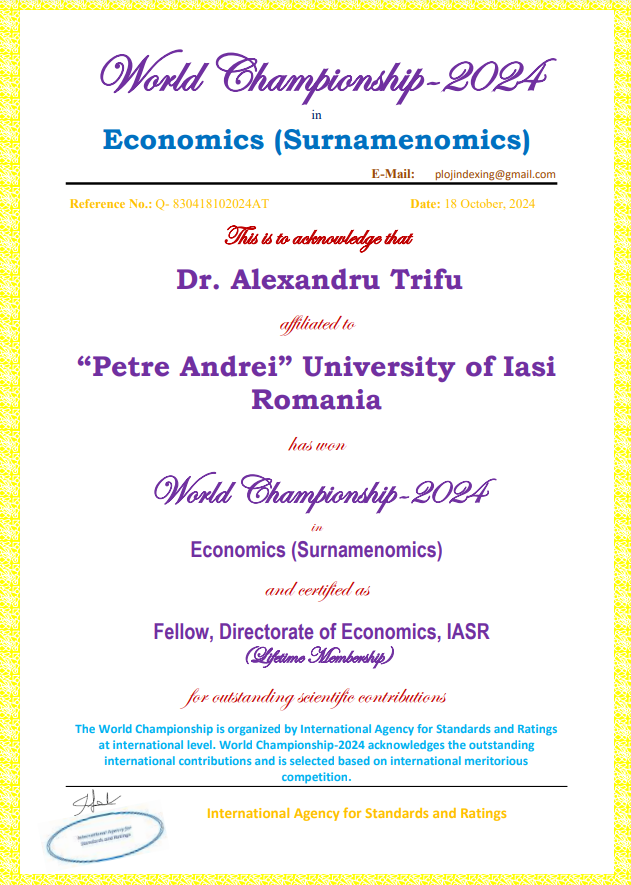
Question: What inspired you to enter into Surnamenomics?
Analyzing the complex universe of today’s Economics, I saw that there exist successful policies (or not), based on someone’s proper name. This means that, apart from collective achievements, this analyzed aspect gives greater weight to the action/achievement. For example, an aspect to be analyzed in a future paper is linked to Indianomics, an extraordinary development of this economy, beyond a threshold attempt as a goal. Furthermore, I was impressed by a list circulated on WhatsApp, presented by India’s Prime Minister Narendra Modi (to the third term) regarding the Indian CEOs of the most important companies in the world, especially in IT and communication. In sum, the quality of Human Resources towards innovation and development.
Question: Since how long have you been into Surnamenomics, and in which cities have you been associated with administration, entrepreneurship, teaching, research, commercial, and training programs?
This interest is recent, more precisely after the pandemic’s end. For these mentioned activities, having a background knowledge in Surnamenomics is an advantage, as it helps recognize both effective policies and results and ineffective policies and failures, enabling better decision-making for real situations and potential profit.
Question: What are your future plans for administration, entrepreneurship, teaching, research, and training programs in Surnamenomics?
This niche economic field is dynamic and improvable. Any economist, practitioner, or analyst can propose a Surnamenomics based on a leading person, an economy’s achievements, or significant results in other fields. The proposal, with solid justification, needs to gain acceptance in the scientific community.
Question: Please introduce yourself. How do you want to be remembered or known in the world?
My name is Alexandru Trifu, Professor Ph.D., Faculty of Economics, "Petre Andrei" University of Iasi, Romania. I am an ex-Dean of the Faculty and currently Head of the Department of Economic Sciences. Economics is my expertise, focusing on Micro and Macroeconomics and cross-interferences with other sciences like Psychology, History, and Geography.
Question: What kind of businesses can be started in Surnamenomics? What minimum infrastructure would it need?
Similar to other start-ups, only a minimum infrastructure/endowment is needed—a computer is sufficient to connect with the world and knowledge/information in any field.
Question: What is Surnamenomics? What are the major branches in Surnamenomics?
Briefly, Surnamenomics may be considered a branch of Economics which starts from a person’s idea, conception, or vision, which can be used and detailed or spread in the benefit of all interested in that action. Also, this branch of Economics may include experiences of countries or organizations which are worth knowing.
Question: What are your recommendations to frame guidelines on funding of research projects on Surnamenomics?
Due to the fact that activities/businesses based on Surnamenomics or including defining elements are generally similar to other businesses, the financing follows the same financial sources as other projects or grants.
Question: How can universities produce revolutionary PhD and Post Doc theses and dissertations on Surnamenomics? What are your recommendations to improve academic standards?
First of all, the thesis must have actual importance and impact. Preparing a thesis requires solid documentation and must include significant achievements in the respective field, incorporating Surnamenomics to enhance its relevance and influence.
Question: How can students seek job and career opportunities in Surnamenomics?
There aren’t specific job opportunities strictly in Surnamenomics, but the knowledge gained in this field can be advantageous for positions where understanding these components is beneficial in securing a balanced and fulfilling career.
Question: What job titles are available in Surnamenomics?
Job titles aren't strictly defined by Surnamenomics. However, utilizing one’s abilities, skills, and understanding of this field can help guide one's business tactics and career path effectively.
Question: Which are the courses available in Surnamenomics?
A single course titled “Surnamenomics” can provide valuable insights into various economic models at both micro and macro levels. This inclusion in basic Economics curricula would allow students to analyze influential examples of action in economics.
Question: What are your recommendations to write a world-class research article in Surnamenomics? What essential components and factors must be there?
A research article in Surnamenomics should focus on exceptional historical economic actions and the resulting impacts. Additionally, contemporary examples should be highlighted, showcasing current influential figures whose actions can serve as case studies for Surnamenomics. The article must clearly convey if these actions and outcomes have broad relevance.
Question: What are your recommendations to improve employment and scope in Surnamenomics?
Understanding Surnamenomics provides a broad base of knowledge that can enhance job applications across public and private sectors by aligning one’s skills with specific role requirements.
Question: What are your recommendations to authors writing books on Surnamenomics for more creativity and understanding of the subject?
Books on Surnamenomics should address core structural issues in Economics and showcase how historical actions have lasting value. Influential books in this field can remain relevant over time, such as “The Colonial Origins of Comparative Development,” which paved the way for future Nobel-winning research.
Question: According to you, what are the Top 5 major challenges (research problems) needing urgent resolution in Surnamenomics?
1. Excessive budget deficits
2. Inflation and interest rates
3. HR challenges from digitalization and AI threats
4. Food security and sustainable agricultural practices
5. Recovery strategies for major economies, such as Germany, to stave off recession.
Question: What are your recommendations to improve standards of Conferences in Surnamenomics?
Conferences in Surnamenomics would benefit from a diverse generational mix of participants to foster creativity and ensure meaningful, broad-ranging discussions.
Question: What are the major challenges for establishing Romania as a global economic power? What are your recommendations?
Romania's ascension as an economic force requires addressing corruption in public administration and establishing consistent public policies. Additionally, strategic coordination of economic policies across Central and East European nations, particularly within the EU, would enhance Romania's competitive positioning in the global market.